Sponsored article
Why Did Bolesławiec Become the Centre of Polish Tableware and Decorative Pottery?
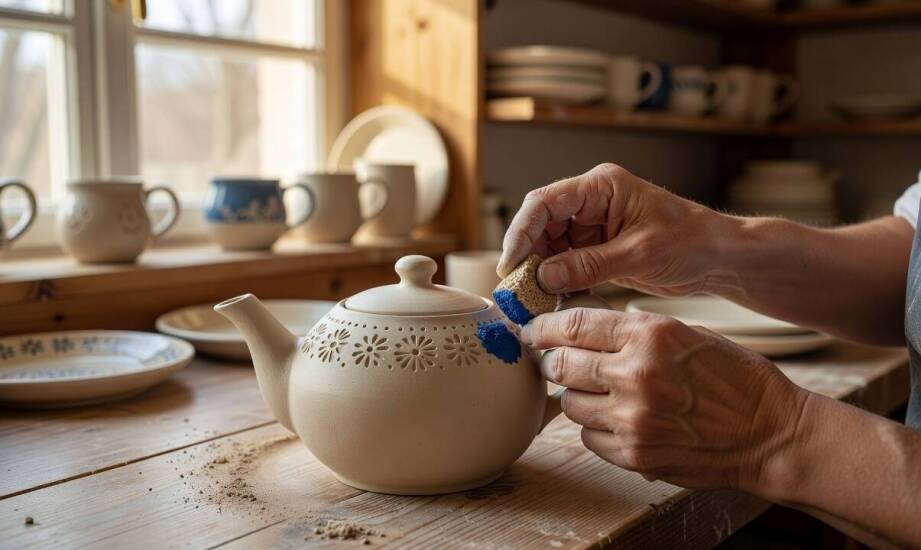
For centuries, Bolesławiec has attracted the attention of art historians, craftspeople and collectors of ceramic tableware. Why did such a strong concentration of traditional stoneware producers develop in this particular part of Lower Silesia?
The answer lies in a unique combination of local geological conditions, access to valuable clay deposits, favourable trade connections and a historical demand for durable household vessels. Over time, these factors led to the development of a highly specialised craft community that refined its methods of forming, decorating and firing ceramics over generations.
Understanding the phenomenon of Bolesławiec therefore means looking first beneath the surface of the region and then inside the old pottery workshops that laid the foundations for the ceramic tradition known today.
How Did Geological Conditions Shape Local Craftsmanship?
The areas around the Bóbr and Kwisa river basins are rich in deposits of stoneware clay suitable for ceramic production. These natural resources played a fundamental role in the development of pottery in and around Bolesławiec.
Local clays contain minerals that make them particularly suitable for producing hard, durable stoneware. Historical sources indicate that pottery was already being produced in the area during the Middle Ages, with the first written references to Bolesławiec potters dating from 1380.
The availability of suitable raw material made it possible to establish a local tradition of ceramic production that continued to develop over the following centuries.
Historical demand for everyday vessels shaped the economic profile of the entire area. During the Middle Ages and early modern period, local potters mainly produced robust jugs, pots, bowls and stove tiles.
The extensive forests surrounding the region also provided the fuel needed to fire traditional kilns. Finished products gradually found customers beyond the immediate local area, helping Bolesławiec build a reputation as an important pottery centre.
Although polish pottery in poland takes many different forms, stoneware from Lower Silesia became one of the products most strongly associated with the Bolesławiec region.
Technological development and growing demand gradually changed the scale of production.
During the eighteenth and nineteenth centuries, small traditional workshops increasingly developed into larger and more efficient manufactories. This transformation allowed production volumes to increase while preserving knowledge of materials and firing techniques accumulated over generations.
Craft organisations also played an important role in regulating the local trade. A potters' guild existed in Bolesławiec by at least 1511, helping organise the profession and maintain standards among local workshops.
Why Do Firing and Decoration Techniques Contribute to the Durability of Bolesławiec Pottery?
One of the foundations of the durability associated with Bolesławiec stoneware is its carefully controlled firing process.
The ceramic body undergoes more than one stage of thermal processing, which gradually transforms the physical structure of the clay.
After drying, pieces undergo an initial bisque firing. In the current production process described by the manufacturer, this takes place at approximately 900°C. After decoration and glazing, the ceramics are fired again at a much higher temperature of around 1250°C.
At these temperatures, the stoneware body becomes strongly vitrified, resulting in a dense and durable ceramic material with low water absorption. This contributes to its resistance during everyday use.
Between firing stages, the vessels are decorated and covered with glaze. During the final high-temperature firing, the glaze forms a smooth protective surface integrated with the ceramic body.
Proper compatibility between the stoneware body and glaze is important because it reduces the risk of surface defects such as crazing and contributes to the long-term durability of the finished piece.
Glazing is only one part of the craftsmanship behind the reputation of Bolesławiec ceramics. The traditional process of applying decorative patterns is equally important.
Classic motifs such as peacock eyes, dots, rosettes and small floral designs are created using the characteristic stamping technique. Historically, sponge stamps played an important role in this decorative tradition, while contemporary production also uses specially prepared rubber stamps.
Stamped decoration became particularly important in Bolesławiec from the late nineteenth century onwards. Museum sources date the emergence of this characteristic technique in the city to around 1882.
Underglaze colours are applied before the final firing, with cobalt responsible for the characteristic deep blue that has become one of the most recognisable features of Bolesławiec pottery.
Hand decoration gives every piece an individual character that cannot be reproduced in exactly the same way by fully automated ornamentation.
Continuity in local ceramic craftsmanship was further strengthened by the establishment of the Royal Vocational School of Ceramics in Bolesławiec in 1897. The institution helped develop technical knowledge related to ceramics, design and production methods.
After 1945, local ceramic traditions were rebuilt and developed by new craftspeople, designers and artists, allowing historic methods and characteristic decoration styles to continue.
The company operating today as Manufaktura w Bolesławcu Smoleński & Zwierz was registered in 2019 and continues the Bolesławiec pottery tradition through the production of functional and decorative stoneware.
Its work combines traditional hand-decoration techniques with contemporary production requirements. Artists associated with the manufactory, including Anna Szeremeta, continue to develop patterns inspired by traditional Bolesławiec aesthetics while creating their own original compositions.
The position of Lower Silesian pottery has been built over centuries through the combination of regional raw materials, high-temperature ceramic processing and attention to decoration.
Local clay deposits gave rise to practical pottery production, which gradually evolved into a highly specialised field of applied art.
Preserving traditional hand-decoration techniques while maintaining carefully controlled firing conditions allows contemporary vessels to remain a tangible continuation of the region's centuries-old ceramic heritage.
The development from medieval workshops to modern manufactories shows how local knowledge can survive while adapting to new production methods and changing expectations.
By combining proven ceramic techniques with contemporary quality requirements, Bolesławiec producers create pieces designed to withstand everyday use while retaining their traditional character.
This conscious preservation of craftsmanship has given local stoneware a lasting place in European material culture and demonstrates how high-quality raw materials, technical knowledge and skilled handwork can successfully complement one another across generations.